Operations
From Software to Science: Venture Capital’s New Frontier is Atoms
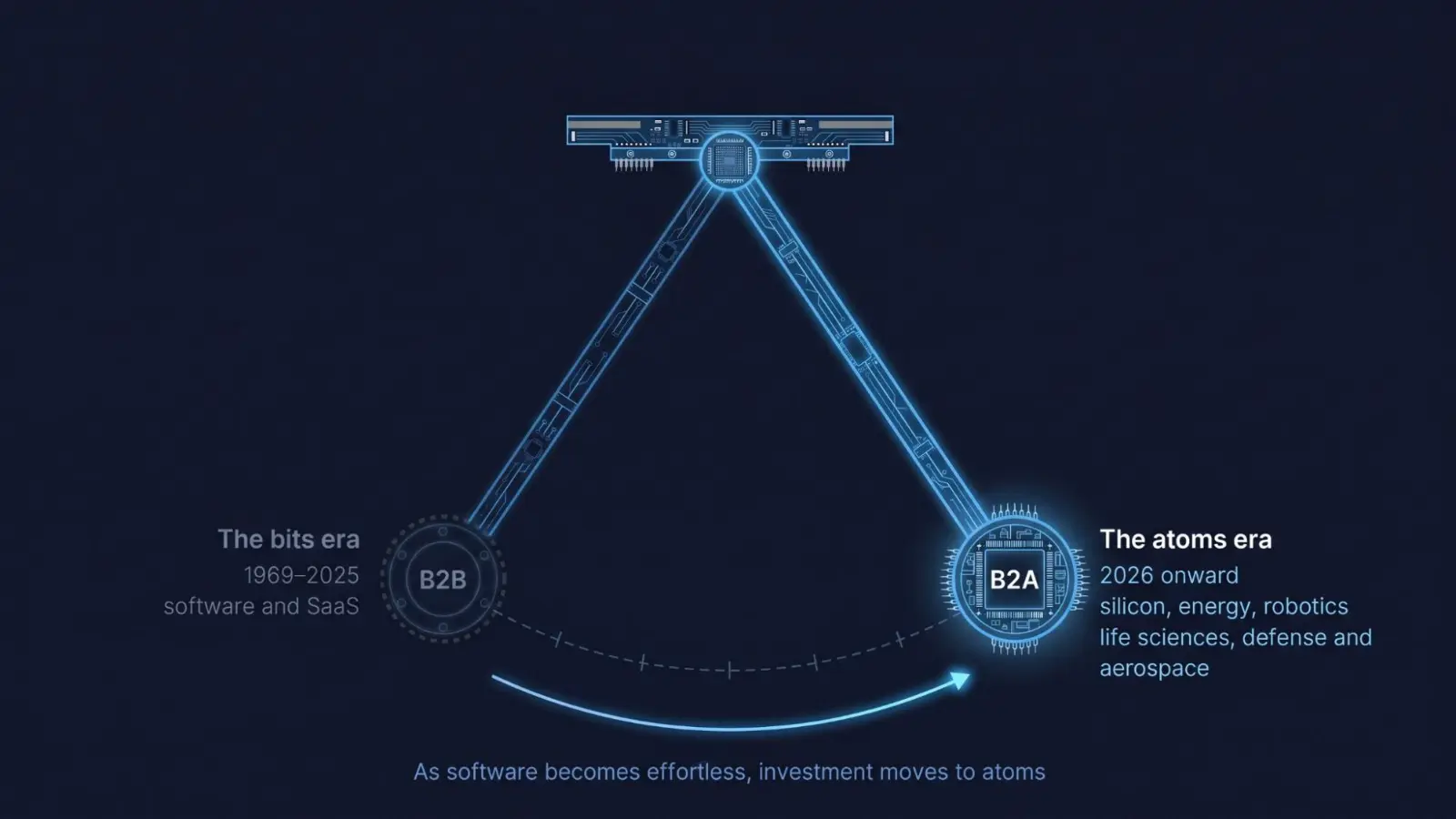
Venture capital began in the physical world. Early investors underwrote the hardware that built the industrial age, from whaling ships and air travel to the semiconductor revolution.
For the past five decades, however, the most defining returns in venture have come from the digital world. This was the software revolution, which built the modern internet and grew software into a $1.4 trillion industry that transformed every economy on earth.
The pendulum has begun to swing again, from bits of software to physical atoms, the building blocks of science. The shift will transform how tomorrow’s biggest ideas are financed and built, and it’s already begun. As the cost of producing software collapses towards the cost of compute and capital flees the SaaS model, money is rotating back to the physical frontier where the industry started. Except today’s frontier is entirely different from the one of 50 years ago. Today’s frontier includes new silicon chips, space technology, versatile robots, clean energy, and life-changing biology.
The software and models that power AI are accelerating this transition. They make atoms cheaper to build and faster to study, and they’re tackling long-unsolvable problems, often finding solutions in months and sometimes days. I call this the B2A era: the moment the world’s breakthroughs move from bits to atoms.
The first era of atoms
Venture capital’s first great customer was, in effect, the Pentagon. From 1946 through the 1960s, the Cold War demand for radar, missile guidance, radiation detection and reliable transistors set the frontier, and early investors followed it. ARD backed High Voltage Engineering’s particle accelerators and Tracerlab’s radiation instruments. Arthur Rock funded Fairchild Semiconductor and Teledyne. DEC and Data General needed heavy capital just to build their assembly lines.
Then, in 1969, IBM bowed to antitrust pressure and unbundled its software from its hardware. Software became something you could sell on its own, and independent vendors no longer had to build computers to build a business.
The economics of bits took over. There was near-zero marginal cost, global distribution without logistics, and capital efficiency that atoms could never match. That one decision set the stage for enterprise and consumer software, the internet and SaaS, the asset class that defined venture for half a century.
When the bits era ended
In February 2026, that 50-year run hit a wall. In late January, Anthropic released plug-ins that let Claude Cowork autonomously handle work like contract review and CRM operations. Days later came Claude Opus 4.6 and demos of agents completing multi-step workflows end to end. Investors did the math on per-seat software when the seat would no longer need a human in it.
The result was what is now known as the SaaS-pocalypse or, my personal favorite, the SaaS-acre. Roughly $300 billion in software value disappeared in a single day in February, and cumulative losses reached an estimated $2 trillion by mid-month. That panic has subsided slightly, but Wall Street has permanently changed its yardstick. Instead of valuing a SaaS company at a high 7x multiple of revenues, we now see more conservative 4x revenue valuations and the Street is increasingly using EBITDA multiples, meaning they are focusing on actual profits instead of top-line sales.
Why software lost its moat
Two forces hit software from both sides at once.
On the supply side, AI coding collapsed the cost of creation. Andrej Karpathy first coined the “vibe coding” term to describe the process of telling an AI what you want and letting it write, test and ship the code. Vibe coding has quickly graduated to high quality, professional software development using AI coding agents. An MVP that once took a team weeks and hundreds of thousands of dollars now takes hours or days and under a hundred dollars. Straightforward workflow software became something an enterprise could clone over a weekend, and the math flipped on whether an enterprise should build versus buy.
On the demand side, agentic arbitrage removed the human from the interface. When an agent works across a CRM, an ERP and a billing system through their APIs, no human logs in. Gartner estimates that up to $234 billion of application software spend, about a fifth of the enterprise SaaS market, may be at risk of disappearing by 2030.
This has major pros and cons, depending on one’s vantage point. Software is becoming abundant, which means rapid adoption and widespread and cheap access. It also means rapid and dramatic margin compression and value loss for enterprise software makers, their employees, and their shareholders.
The pendulum swings back to atoms
Here is the B2A thesis: when the cost of producing bits approaches zero, value migrates to the technologies that are still defensible investments. Increasingly, what is still defensible is physical.
In Q1 2026 alone, the four top hyperscalers spent a combined $130 billion on capex: land, concrete, transformers, cooling and GPUs. Budgets that once paid for SaaS subscriptions are being redirected into compute. AI, the purest expression of bits ever built, turns out to run on an extraordinary quantity of atoms.
Venture is following. In 2026, Dealroom called out the shift to physical infrastructure, noting that private and public equity are funding compute, power, robotics, and defense at breakneck speed. Crunchbase counts nearly $42 billion of venture money that went into physical AI companies between 2022 and 2024, and the pace accelerated in 2026.
That’s not to say that venture has stopped funding software. Just that it has stopped funding the old kind. Roughly half of all venture dollars in 2025 went to AI companies, and the software rounds still getting done are overwhelmingly AI-native, including foundation models, coding agents, and AI infrastructure. Traditional SaaS, with its seat-based pricing and interface lock-in, is out of fashion. Founders building SaaS products now face the same question investors are asking of public SaaS companies: what is left that an agent cannot clone or route around?
Two key forces are driving the swing.
Defensibility has moved. Code is now cheap. But fab capacity, grid interconnects, specialized materials, wet-lab throughput and manufacturing know-how are not. You cannot vibe-code a 2nm wafer, a substation, or a Phase II clinical trial. These take years, considerable capital, and hard-won expertise, the very things that made atoms unattractive in the SaaS era and make them defensible now.
AI is making atoms cheaper. The old venture capital critique for atoms needs a refresh. The math has changed on long R&D cycles, costly prototypes, and slow regulatory oversight. The same AI that is deflating software is also deflating the cost of physical materials discovery and development.
Understanding the AI Effect
This is the most underappreciated part of B2A. AI coding has cut the cost of a software MVP by three to four orders of magnitude. Something similar is starting to happen to the lab, the fab, and the factory.
The bottleneck in atoms has always been the iteration loop. Every hypothesis meant a synthesized compound, a tape out, a machined prototype, a test rig or a clinical cohort, each costing time and money. AI moves much of that loop into software. Models screen millions of candidates before a single experiment, simulation replaces early prototypes, and generative design delivers complete engineering drawings. Self-driving labs now close the loop. AI picks the next experiment and robots run it around the clock.
The bigger shift is that problems once considered unsolvable are getting unlocked. Below are six major breakthroughs in frontiers long elusive to human researchers or completely out of reach.
- Protein folding. A 50-year grand challenge in biology was effectively cracked by AlphaFold, which has predicted structures for nearly every known protein and helped earn the 2024 Nobel Prize in Chemistry.
- Materials discovery. DeepMind’s GNoME proposed hundreds of thousands of new stable crystal structures, far more than decades of human research had catalogued.
- Energy discovery. Zanskar has built an AI world model for the subsurface, enabling them to discover and deliver geothermal energy at record-setting accuracy and speed.
- Quantum Computers. AI is accelerating the design and construction of quantum computers in three ways: improving the quantum processors, correcting errors from noisy qubits, and generating new circuit reduction techniques to make quantum algorithms more efficient.
- Robot planning. Large language models like GPT-6 Astra are enabling robots to plan which action to take next without costly training and customization.
- Chip design. AI floorplanning has reportedly produced layouts in hours that once took engineers weeks.
These are not incremental gains. They turn search problems with astronomical possibility spaces into tractable engineering. For investors, that rewrites the risk profile of atoms. Less capital is burned on dead ends, proof arrives faster, and new markets open that did not exist when the science was unsolved.
Atoms are still harder than bits. But for the first time in fifty years, they are getting easier and faster to build.
Where capital is betting on atoms
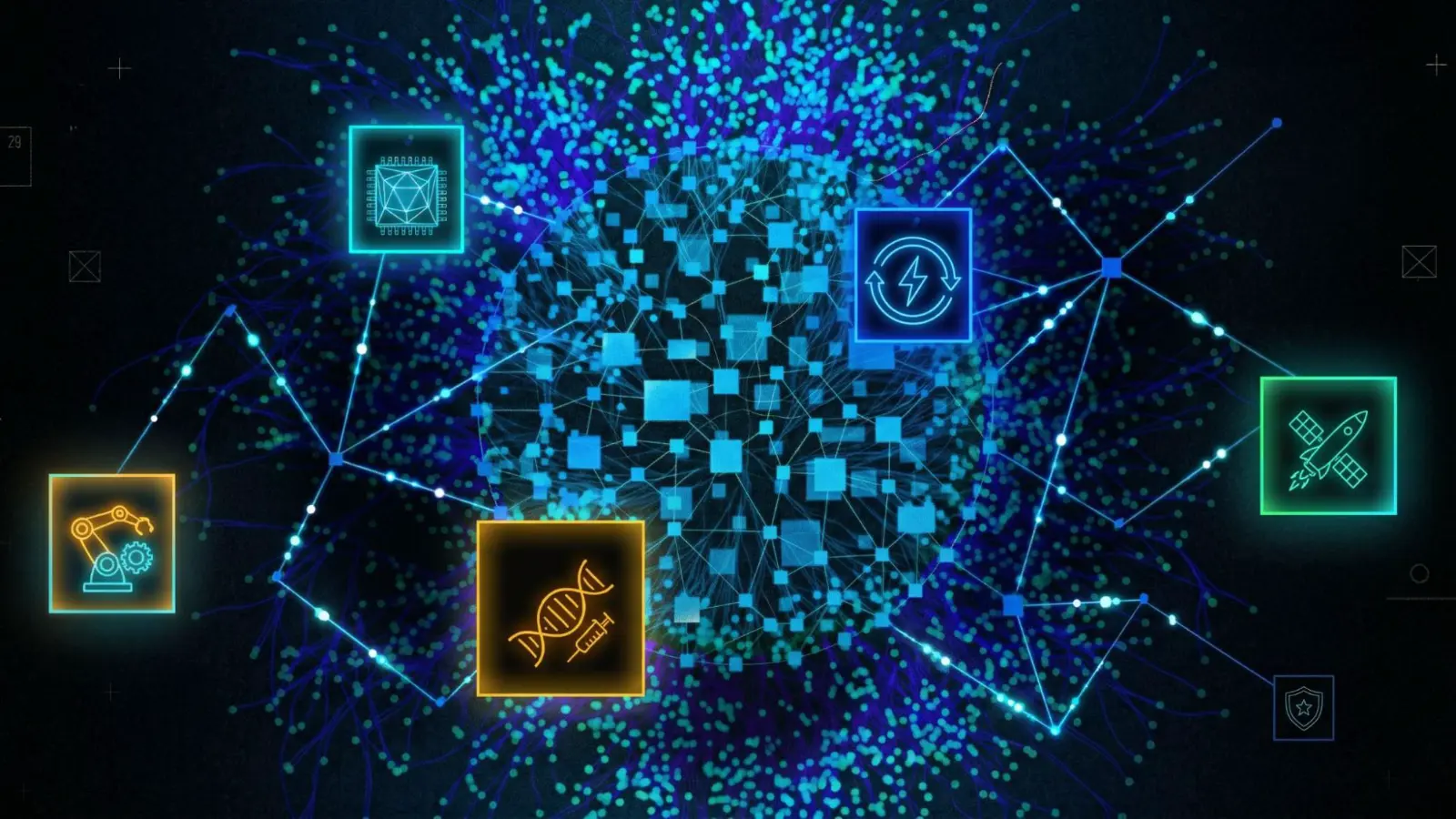
As AI is making atoms easier to build, the next question is where that shift is landing first. The areas below are where I see the physical bottleneck to be most acute, and where AI does the most to loosen it. They’re also where venture capital is starting to flow.
Silicon. Every AI token runs on a chip, and demand for compute, memory, interconnect, and advanced packaging is running ahead of supply. Startups in inference silicon, photonics and memory-design sit at the inflection point of the new economy.
Energy and infrastructure. Data centers are increasingly limited by power, not just GPUs, and the AI buildout is forcing investors to fund the physical constraints of computing. Generation, grid hardware, storage and cooling, including next-generation nuclear and geothermal, are now venture categories.
Robotics. Robotics has long had a unit economics problem, as training a model for each bespoke use case is infeasible. Generalized models that allow robots to perceive, plan and control actions are bringing rapid automation to warehouses, factories, construction sites and farms, and labor shortages make the demand real.
Biological breakthroughs. AI is transforming life sciences into what we have called Generative Science. New approaches at the intersection of AI and biology hold the promise to design sequence-based medicines with superior properties across many different modalities and delivery mechanisms. In parallel, lab automation and biomanufacturing are reshaping the field.
Defense and aerospace. Venture’s first customer is back, buying autonomous systems, space hardware and resilient manufacturing. As in 1946, national security demand is again shaping the frontier. Defense is not an investment area for Obvious, but it is clearly a big and growing part of today’s venture ecosystem.
What it means
For investors, atoms demand different muscles. They require longer horizons, tolerance for capex, real technical diligence, and comfort selling to strategic and government buyers. Funds built on capital-light SaaS playbooks will need to retool and pivot.
For founders, the opportunity is in the hard parts. Use the near-free software layer to move faster on the physical one.
The strongest B2A companies will use atoms for defensibility and AI-generated bits for speed.
For SaaS, I don’t see this as the end. Infrastructure and data platforms are thriving, and vendors that own proprietary data become systems of record for agents and price on outcomes will endure. But the previous venture assumption—that the best returns live only in software—needs a hardware upgrade.
At Obvious, we’ve been executing on this B2A thesis for over a decade. Our early investments in Diamond Foundry (2014), Planet (2015), Recursion (2016), and Dexterity (2017) have prepared us for this pendulum swing. Our current work in energy, robotics and generative science is centered on this new era of AI-accelerated atoms, where the best companies fuse the two.
In 1969, IBM’s unbundling taught venture capital that bits were the better business. In 2026, AI is teaching the opposite lesson. Software is abundant, defensibility requires a real IP moat, and AI is now making atoms tractable. The pendulum has swung, and the next generation of great venture-backed companies will be built in the middle, where bits and atoms meet. Welcome to the B2A era.

Obvious Ideas